One and the Same...
the god of many names...
"Listen, people of Israel! The Lord is our God. The Lord is the only God. The Lord alone is our God. There is no other true God."
- Deuteronomy 6:4
"To us there is but one God, the Father, of whom are all things, and we in him; and one Lord Jesus Christ."
- 1 Corinthians 8:6
"There is no God but Allah, and Muhammad is his messenger."
- Quran/Shahada - From the Five Pillars of Islam
Western Religions
It gets confusing doesn't it?- How can each religion claim to have the only God? Throughout history, so much turmoil and violence were perpetrated in "God's" name. But the truth for any believer is simple: They are "one and the same."
- Jehovah (Judaism)
- God (Christianity)
- Allah (Islam)
- The Great Spirit, Wakan Tanka or Gitche Manitou (Native American)
Latin (Gregorian Chant)
Sanctus, Sanctus, Dominus
Te Deum laudamus
Te Dominum confitemur
Omnis terra venerator.
(Holy, Holy, Holy,
Lord God of Hosts
We acknowledge You as the Lord
All the earth worships You.)
Arabic (Muslim Prayer)
Alhamdulillah
Kull al-ard tasjudu lak
Rabbe zidni ilma
Allaho akbar
Rabbe zidni ilma
Wa alaikum salaam.
(Praise be to God,
All the earth worships You
O Lord, increase my knowledge
Allah is the Greatest
Peace be on you too.)
© Richard Coffey - All Rights Reserved
Music, Lyrics, Vocals: Rich Coffey
Recorded at Mistura Productions
About the Music
This soundscape was created around the wonderful sound of the frame drum. It illustrates, throughout history, how the frame drum was tied to spiritual ceremonies in a variety of cultures (in this instance both Christian and Muslim holy praise but of course it was prevalent in Native American and Southeast Asian religious ceremonies as well).
The tune opens with a pseudo Gregorian Chant (sung in Latin) and is followed by a Muslim Prayer (sung in Arabic- crudely but sincerely!). As the Muslim's prayer continues, a muezzin's call to prayer is heard from the mosque's minaret in the distance.
The percussion tracks are played live (and looped accordingly) and feature the frame drum, a small doumbek (a.k.a. "darbuka"), a caxixi and a tamborim (small hand drum).
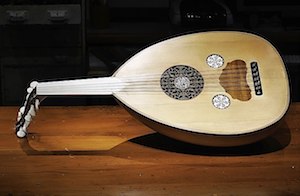
The Middle Eastern stringed instruments (the oud and rebab) are patches on the Casio PX-S3000.
- About the Instrumentation -
The Frame Drum
A frame drum is one of the most ancient percussion instruments, defined by a drumhead wider than its depth, stretched over a shallow wooden frame called a shell. It is played with hands, fingers, or sticks, and is found across the world in cultures from Mesopotamia to Ireland.
Types & Examples:
- Bodhrán: Irish frame drum, often with a crossbar.
- Bendir: North African/Middle Eastern drum with a snare.
- Daf: Persian/Middle Eastern frame drum used in Sufi music.
- Tar: Middle Eastern drum with snares.
- Buffalo Drum: Native American style drum.
- Listen to a Master Glen Velez

Darbuka (Doembek)
A doumbek (or darbuka) is a single-headed, goblet-shaped drum central to Middle Eastern, North African, and Balkan music, played by hand to produce deep bass ("doom") and sharp, high-pitched "tek" or "ka" sounds, using fingers and palms on its synthetic or skin head, making it a versatile percussion instrument for rhythmic and melodic textures. While it’scommonly referred to as “Doumbek” in the West, it’s known as “Darbuka” in Turkey.

Ney
The ney—known for its expressive, breathy sound—is an ancient, end-blown reed flute central to Middle Eastern, Persian, and Turkish music. In some of these musical traditions, it is the only wind instrument used. The ney has been played for over 4,500 years, dating back to ancient Egypt, making it one of the oldest musical instruments still in use.

Tamborim
A tamborim is a small round Brazilian frame drum used in many genres of Brazilian music. The frame is 6" in width and may be made of metal, plastic, or wood.[ The head is typically made of nylon and is normally very tightly tuned in order to ensure a high, sharp timbre and a minimum of sustain. The drum is devoid of snares or jingles.
- Tamborim
- Listen: Meinl Floatune Tamborim

Caxixi
A caxixi is a hand-held percussion instrument consisting of a closed basket with a flat bottom filled with seeds or other small particles. The round bottom is traditionally cut from a dried gourd. Variations in sound are produced by varying the angle at which the caxixi is shaken, determining whether the contents strike the reed basket (softer sound) or the hard bottom (louder, sharper sound).

Rebab
The Rebab is an Arabic string instrument typically bowed, but is sometimes plucked. It is one of the earliest known bowed instruments, named no later than the 8th century, and is the parent of many bowed and stringed instruments. It was developed under Muslim culture and continues to be used in Arabic Bedouin music.
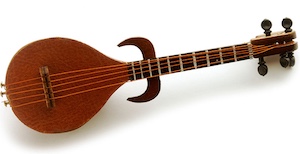
Oud
The oud is a pear-shaped stringed instrument that has been used in Middle Eastern music for centuries. It has a unique sound that is instantly recognizable and often used in traditional and contemporary Middle Eastern music. It is believed to have originated in Persia and spread to the Arab world during the Islamic Golden Age.